• Tutorials
    • Forms, Navigation
    • Forms, Popup and Context Menus
    • Forms, Color of Fields
    • Forms, Changing the Font
    • Forms, Customizing
    • Forms, Printing Reports
    • Forms, Send Email
    • Forms, Help
    • Grids, Navigation
    • Grids, Scrollbars
    • Grids, Functions
    • Grids, Functions, Refresh
    • Grids, Functions, New Wizard
    • Grids, Incremental Search
    • Grids, Selecting Multiple Records
    • Grids, Find and Find Next
    • Grids, Filters
      • Filters, Creating a New
      • Filters, Getting Fancy
      • Filters, Saving and Reusing
      • Filters, Default Filters
    • Grids, Printing Reports
    • Grids, Customizing
    • Menus, Shortcut Keys
    • Forms, Form Letters
      • How to print a Form Letter, Richtext
      • How to print a Form Letter, PDF
      • How to create your own Form Letter
  • Webinars
  • Training
    • Windows XL Training
    • Mobile Delivery
  • What’s New
  • Follow us on Twitter

TeamDME! XL Help

  • System
    • Company
    • Postal Codes
    • Task
    • User Security
    • Dashboard
    • Report Designer
  • Inventory
    • Item
    • Item Category
    • Item Department
    • Item Manufacturer
    • Item Location
    • Tracked Item
    • Activity
      • Physical Count
      • Item Adjustment Edit
      • Service Transaction Edit
      • Item Transfer Edit
    • Reports
  • Orders
    • Diagnosis Code
    • HCPCS Procedure Code, Edit
    • HCPCS Procedure Modifier
    • HCPCS Coverage Criteria List
    • HCPCS Fee Schedule
    • Physician
    • Payor
    • Therapist
    • Facility
    • Quote
    • Medical Order
    • Point-of-Sale
    • Recurring
    • Claim Pending
    • Claim History
    • Reports
  • Receivable
    • Customer
    • Salesperson
    • Referral
    • Nonallowed Reason
    • Responsible Reason
    • Adjustment Reason
    • Payment Type
    • Payment
    • Reports
      • Aged Receivable Reports
      • Revenue Reports
      • Audit Reports
      • Finance Fee
      • Customer Statement
      • Collection Letter
  • Purchase Orders
    • Purchase Order
    • Purchase History
  • Payables
    • Vendor
    • Unposted Invoice
    • Unpaid Invoice
    • Reports
      • Aged Payable
      • Open Payable
      • Cash Requirements
      • IRS 1099 Forms
  • Ledger
    • Chart of Account
    • Journal Unposted
    • Journal History
    • Bank Register
    • Reports
      • Balance Sheet
      • Income Statement
      • Trial Balance
  • Windows
You are here: Home / Receivable / Reports / Aged Receivable Reports / Aged Receivable, by Reports
«« Aged Receivable ReportsWhat do the Columns represent on an Aging Report? »»

Aged Receivable, by Reports

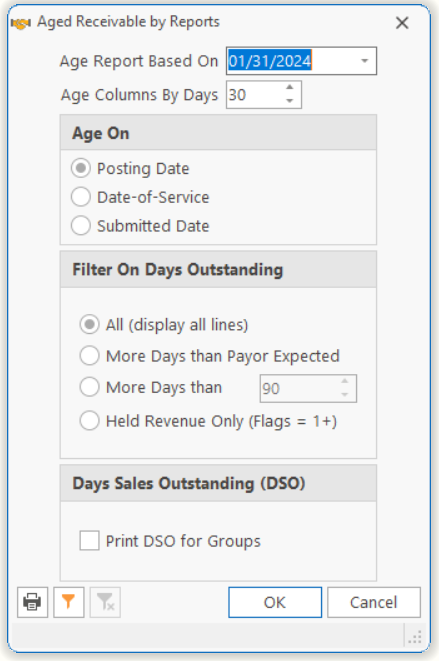
This report prints your Accounts Receivable, outstanding balances of payors and customers.

Age Report Based On The date from which to age the Claims/Invoices, to determine whether they are Current, Under 30, 60, 90, 120, 150, or over 150 Days.

Note: This date also serves as a limit to timeframe to print. If you enter 12/31/2010, then only transactions which have a Posting Date of this and prior will be included on the report. This means that assuming you do not later post something prior to 12/31/2010, the report will print the same today, next month and next year.

Age Columns by Days The number of days each column on the Aging Report should represent.
Age On
Posting Date This aging allows you to see how quickly you get paid from the Posting Date. This report can be reconciled to the Revenue reports, and all other reports in the system.
Date of Service This aging allows you to see how quickly you get paid from the time services are rendered.
Submitted Date This aging allows you to see what has not been paid in a reasonable time from the Last Submitted date.
Filter on Days Outstanding
All This prints all items without any filtering.
More Days than Payor Expected This prints only Items which are beyond what we expect from each Payor.

See “Expected Days” in Payor Edit, Settings

More Days than X This prints only Items which are beyond the selected number of days.

Example: If you want to print only items which are beyond 90 days, you will click this and enter 90. The result would be nothing in the Current, Within 30, 60 and 90 Day columns.

Page Tags: Aged, Receivable, Reports
«« Aged Receivable ReportsWhat do the Columns represent on an Aging Report? »»

Tell us what you think. Cancel reply

You must be logged in to post a comment.

RETURN TO TOP

Copyright 2014-2026 · TeamDME!, Inc. · All Rights Reserved · Log in